Retell AI review

Retell AI
The category leader for AI voice agents — strong technical foundation and the right choice when phone is non-negotiable for your use case.

OVERALL SCORE
7.9
out of 10
External link · opens in new tab
TL;DR
Retell AI is the most technically polished voice agent platform on the market in 2026 — and voice agents have moved from gimmick to production reality this past year. If phone calls are part of your customer experience (support, sales qualification, appointment booking, surveys), Retell is the strongest default. The legal complexity around outbound calling is the major caveat and lives upstream of platform choice.
Who it’s for
Retell fits operations teams whose work includes meaningful phone-call volume: customer support, sales SDR functions, healthcare scheduling, field service dispatch, restaurant reservations, real estate qualification. The platform shines on inbound (where intent is high and legal exposure is low) and is more complicated on outbound (where compliance dominates).
The hidden prerequisite: somebody on your team has thought through the call flows in detail. Voice agents fail more visibly than chat agents — users hear awkward pauses, missed comprehension, repeated questions. Designing call flows that handle interruptions, accents, and ambiguity is its own craft.
At a glance
- Pricing: Usage-based — roughly $0.10-0.30/voice minute plus LLM tokens; free trial credits to start
- Billing: Monthly or pay-as-you-go
- Telephony: Native SIP, plus Twilio and Vonage integrations
- Models: Multiple TTS voices, ASR options, and LLM choices (GPT-4 class, Claude class)
- Voice cloning: Available at extra cost; quality varies by language
Features deep-dive
Latency engineering. Retell’s defining feature is sub-800ms response latency, achieved through streaming ASR + streaming LLM + streaming TTS, plus aggressive optimization of the model selection and prompt construction. This single number — the gap between user finishing a sentence and agent starting to respond — is what makes the agent feel “human” or “robotic.”
Call flow builder. Visual editor for designing conversation flows: greeting → intent detection → branching paths → escalation. Functions can be called at any node. Handoff to a human agent (with full transcript) is a first-class feature.
Function calling. During a live call, the agent can call your CRM, calendar, inventory system, or any HTTP endpoint. The trick is latency — every function call extends the silence between user input and agent response. Production flows minimize function calls during conversation and batch operations at the end.
Compliance tooling. Call recording, redaction of sensitive data (PCI, PII), GDPR-compliant data retention, and consent capture are all built in. The platform doesn’t make you compliant — only your legal team can — but it provides the controls your legal team will ask about.
Pricing analysis
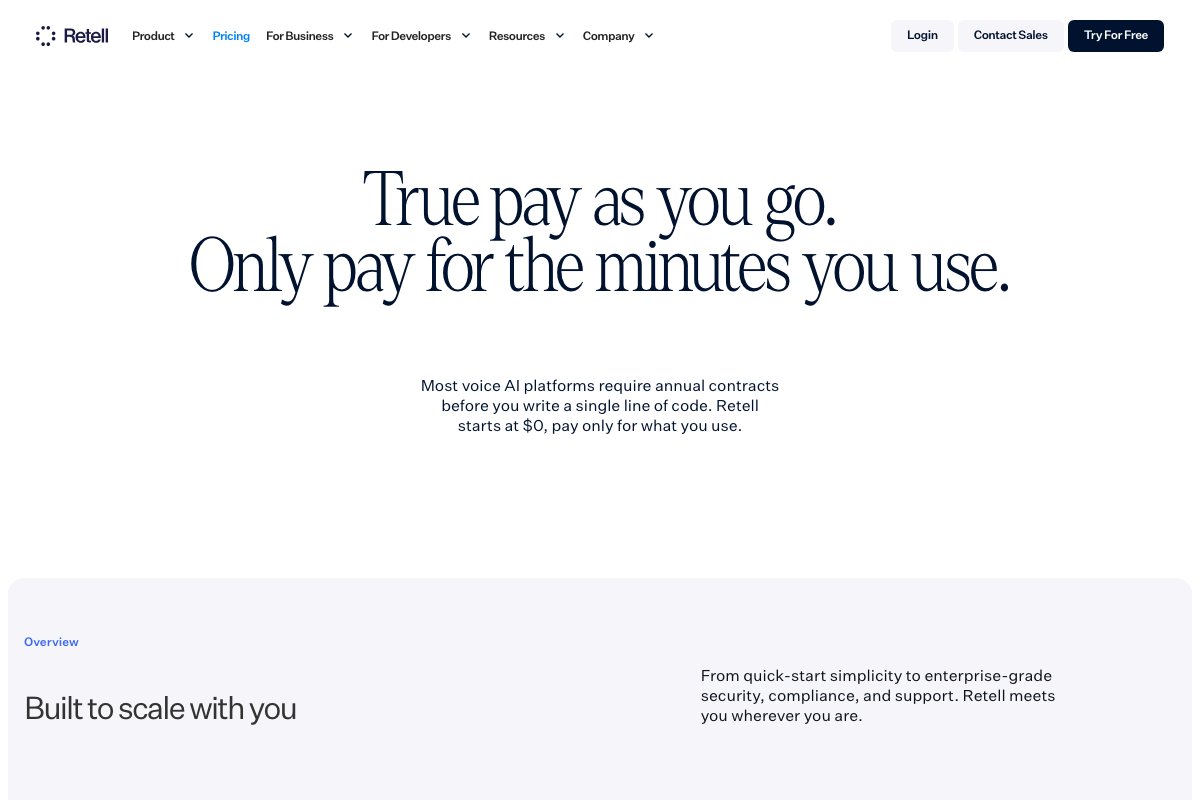
At $0.10-0.30 per minute, voice agents are economic against human agents almost everywhere. A typical contact-center agent costs $25-50/hour fully loaded; that’s $0.42-0.83/minute. So even at the high end of Retell pricing, you save 50-80% vs human cost per minute, and the agent handles unlimited parallel calls.
The non-obvious cost: building and tuning the call flows. Plan for 2-4 weeks of design work per major flow, including testing with real users. Skipping this produces the kind of bad voice-agent experiences that damage brand.
Strengths
The latency is real and noticeable. Side-by-side tests with competitors show Retell consistently leading on perceived responsiveness. This translates directly to better user experience and higher task completion rates.
The compliance features are unusually mature for a young company. Audit logs, consent records, redaction — these typically take years to ship and Retell has them. For regulated industries (healthcare, finance, insurance), this is a serious de-risking factor.
Weaknesses
Voice-only positioning is both a strength (focused excellence) and a limitation (no omnichannel story). If your use case spans chat + email + phone, you’ll integrate Retell alongside other tools rather than using it as a single platform — and the integration work adds up.
Outbound calling at scale lives in dangerous regulatory territory. The platform doesn’t enforce TCPA, GDPR, or local equivalents — that’s your job. I’ve seen well-meaning teams blow up their compliance posture in 48 hours by launching outbound campaigns without legal review. Retell doesn’t stop you. Your lawyer should.
Verdict
For inbound voice agents — support, qualification, scheduling, surveys — Retell is the strongest default on the market in 2026. The technical foundation is excellent and the compliance tooling is mature. For outbound, the platform is capable but the legal layer above it dominates the decision. See FAQ below.
FAQ
-
How does Retell compare to Vapi and Bland? +
All three operate in the same space. Retell tends to lead on call-flow tooling and latency. Vapi has stronger developer ergonomics for builders. Bland focuses on outbound dialer scale. Run a head-to-head trial — the differences matter at production scale.
-
Can Retell take actions during a call? +
Yes via function calling: the agent can lookup CRM records, book calendar slots, check inventory, or trigger a follow-up email — all while staying in the conversation. Latency on function calls is the main UX constraint.
-
Is Retell legal for outbound sales calls? +
It depends on jurisdiction and configuration. TCPA in the US, GDPR in the EU, and similar rules elsewhere place hard limits on outbound calling. Retell provides the technical capability; legal compliance is the operator's responsibility. Get counsel before launching outbound.
-
What does Retell cost in practice? +
Roughly $0.10-0.30 per minute of voice time depending on model and voice quality. A 5-minute support call costs $0.50-1.50 in platform costs plus LLM tokens. For inbound support replacing live agents at $30+/hour, the math works easily.

Stéphane Viaud-Murat
CEO, mi4.fr