LangChain review

LangChain
The most complete framework stack for building agents in 2026 — the right default when your team can read Python or TypeScript and your application needs explicit state.
OVERALL SCORE
7.9
out of 10
External link · opens in new tab
TL;DR
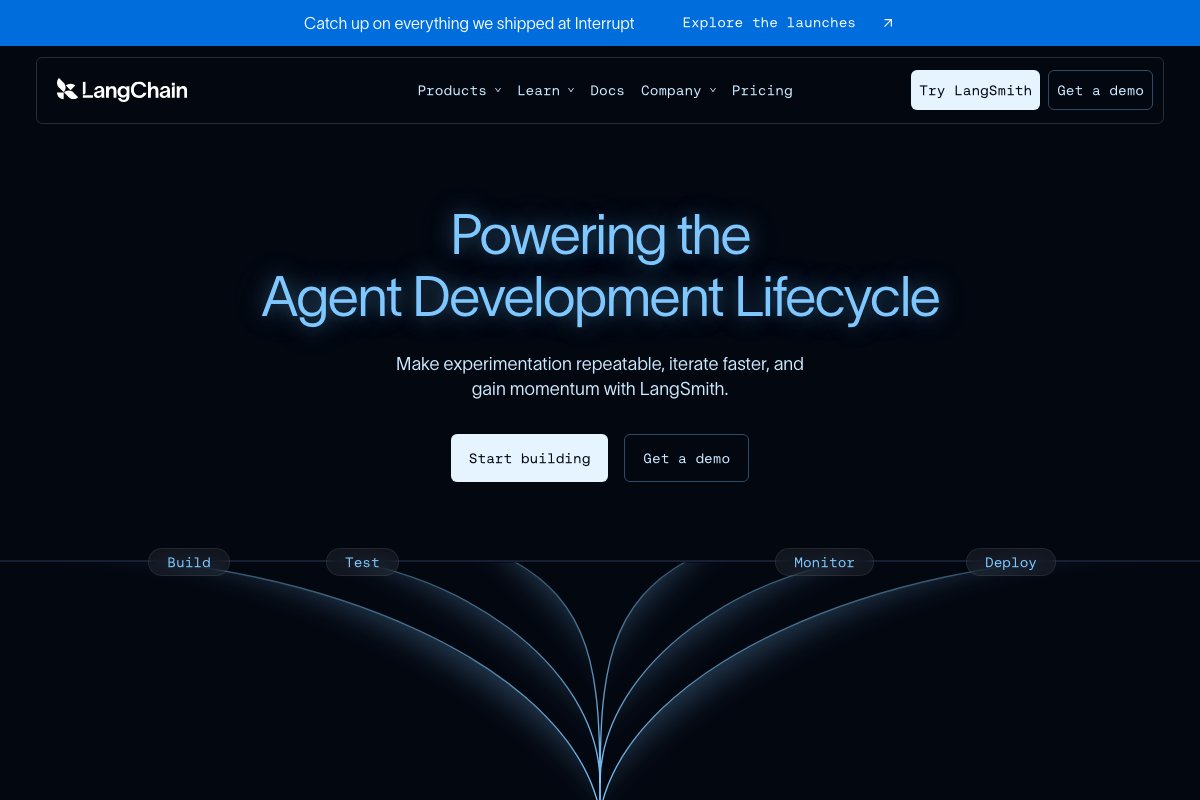
LangChain is the most complete framework stack for production agent applications in 2026. The three pieces — LangChain (libraries), LangGraph (orchestration), LangSmith (observability) — cover the lifecycle that most teams need to build, ship, and operate agents. The trade-off is API churn and a real risk of over-engineering. For teams shipping more than a prototype, the stack pays for itself; for one-off scripts, it’s overkill.
Who it’s for
LangChain fits engineering teams building applications where the LLM is more than a single API call: agents with tools, multi-step workflows, retrieval pipelines, evaluations, monitored production deployments. Solo developers, ML platform teams, AI product squads, and consultancies all have natural use cases.
The hidden requirement: at least one engineer who has shipped an LLM application before. LangChain’s surface area is large; new users frequently learn the framework instead of solving the problem. The on-ramp is steeper than competitors marketed at non-engineers (Lindy, n8n) and the payoff arrives at the second or third application built, not the first.
At a glance
- Pricing: OSS framework free; LangSmith from ~$39/month per developer seat; LangGraph Platform usage-based
- Billing: Subscription (LangSmith) and usage (LangGraph Platform, LLM tokens)
- Free trial: OSS is free; LangSmith free tier covers small projects
- Languages: Python and TypeScript with first-party parity
- Models: All major providers (OpenAI, Anthropic, Google, Cohere, open-weight via Ollama, vLLM, etc.)
Features deep-dive
LangChain core. The library layer: model abstractions, prompt templates, output parsers, document loaders, retrievers, and tool definitions. Most code that interacts with an LLM goes through this layer. The Python and TypeScript packages are kept at functional parity, which matters for full-stack teams.
LangGraph. The orchestration layer: stateful graphs where nodes are functions and edges are conditional. This is the framework’s strongest argument in 2026 — agents modeled as explicit state machines are easier to debug, more deterministic, and integrate cleanly with human-in-the-loop. Hierarchical and parallel patterns are first-class.
LangSmith. Observability and evaluation. Every chain or agent run produces a trace; traces include inputs, outputs, latency, costs, and tool calls. Evaluations run against datasets with multiple metrics. The dashboard quality is the best in the open ecosystem in 2026 — meaningful gap over self-rolled monitoring.
LangGraph Platform. Managed deployment for LangGraph applications: persistent threads, scheduled crons, scale-to-zero, and built-in agent state storage. Removes most of the DevOps work for teams who don’t want to run agent infrastructure themselves.
Pricing analysis
LangChain (the OSS library) is free; you pay for LLM tokens consumed by your application.
LangSmith starts free for hobby use, with paid seats at roughly $39/developer/month for production trace volume. Teams shipping more than a few thousand traces per day move to volume-based plans. The pricing is fair against the alternative (rolling your own observability with OpenTelemetry + custom storage).
LangGraph Platform pricing combines compute and storage components. A real production deployment with moderate volume lands in the low-to-mid four figures monthly. Negotiable at scale; the headline rates favor evaluation-stage teams over enterprise.
Compared to direct SDK + custom infrastructure: the LangChain stack saves engineering time at the cost of vendor dependence. The break-even is typically 3-6 months — i.e., a team that would have spent that time building observability and orchestration tooling captures the value, whereas a team that wouldn’t have built those things pays for them anyway.
Strengths
The framework has won on documentation density. Two years of being the de-facto reference means Stack Overflow, blog posts, YouTube tutorials, and ChatGPT all answer LangChain questions well. The compounding effect on time-to-solution is real and underrated.
LangSmith’s evaluation tooling is the most mature in the open ecosystem. Defining eval datasets, running comparisons across prompt versions, and tracking regressions are operations that competing frameworks force you to build yourself. For teams serious about agent quality, this single feature can justify the stack choice.
Weaknesses
The framework has churned through three to four major API generations in three years. Codebases written against early LangChain often need substantial rewrites to reach current best practices. The stability has improved with LangGraph’s 1.0 release, but historical scar tissue is real.
The temptation to model every problem as a graph is strong and frequently wrong. I’ve reviewed agent applications built on LangGraph with 15+ nodes where 3 well-placed if-statements would have done the job. The framework’s expressiveness is genuine but it’s not always called for.
Verdict
LangChain (with LangGraph and LangSmith) is the right default for engineering teams building serious agent applications in 2026. The framework’s breadth, language parity, and observability tooling give it a structural advantage that the ecosystem hasn’t matched. The on-ramp is steep, the API churn is real, and the over-engineering risk is present — none of which disqualifies the stack, all of which calibrate when it’s the right call. See FAQ below.
FAQ
-
Is LangChain still relevant in 2026, or has it been replaced by alternatives? +
Still relevant — and arguably more relevant than two years ago. The framework has consolidated around LangGraph (orchestration) and LangSmith (observability). Direct competitors exist (CrewAI for multi-agent, raw model SDKs for simple cases) but no single stack matches LangChain's breadth in 2026.
-
Should I use LangChain or just the OpenAI/Anthropic SDK directly? +
Use the direct SDK when your application is a single call with one tool list. Use LangChain when you need orchestration, state, retries, observability, or model-provider abstraction. The threshold is roughly: more than ~50 lines of agent logic suggests LangChain pays off.
-
What's the actual cost — framework is free but what about LangSmith and LangGraph Platform? +
LangChain (OSS) is free. LangSmith pricing scales with trace volume — a small team's bill is typically $39-300/month. LangGraph Platform pricing is per-deployment with usage components — production deployments often land in the low four-figures monthly. Negotiable at scale.
-
How does LangGraph compare to CrewAI? +
Different abstractions. LangGraph models agents as explicit state machines with nodes and edges. CrewAI models agents as role-playing collaborators with tasks. LangGraph wins when control flow is the hard part; CrewAI wins when role decomposition is the hard part. Both are production-viable; the right choice depends on how you model the problem.

Stéphane Viaud-Murat
CEO, mi4.fr