Crew AI review

Crew AI
The reference multi-agent framework when collaboration between specialized agents genuinely solves your problem — and the right escape hatch when single-agent platforms hit their ceiling.
OVERALL SCORE
8.1
out of 10
External link · opens in new tab
TL;DR
CrewAI is the cleanest multi-agent framework in production use in 2026. If your work decomposes naturally into specialized roles that collaborate, Crew gives you the right abstraction. Outside that scope — for single-agent tasks or simple workflows — it’s overkill. The Python-only constraint and the opaque Enterprise pricing are the real friction points.
Who it’s for
CrewAI fits engineering teams building complex agentic systems where role separation actually helps. Research-and-writing pipelines, software engineering agents (planner + coder + tester), customer journey orchestration, financial analysis workflows — these all benefit from the Crew abstraction. Marketing automation and simple integrations are usually better served by Lindy or n8n.
The hidden requirement: at least one engineer who has thought hard about agent design. CrewAI gives you the building blocks but doesn’t tell you whether decomposing your problem into multiple agents is the right call. That’s a real failure mode I’ve seen — teams adopt CrewAI for problems a single well-prompted agent would solve faster and cheaper.
At a glance
- Pricing: OSS framework free; Enterprise platform contact-for-pricing
- Billing: LLM tokens (variable); Enterprise platform monthly or annual
- Free trial: OSS is freely usable; Enterprise has trial via sales
- Integrations: Python ecosystem — any LangChain tool, MCP servers, HTTP APIs
- Models: All major providers (OpenAI, Anthropic, Google, open-weight via Ollama)
Features deep-dive
The Crew model. A Crew has agents (each with a role, goal, backstory, and tools) and tasks (each with a description, expected output, and an assigned agent). The framework executes tasks sequentially or hierarchically, passing outputs as inputs to the next task. This maps well to how human teams actually work.
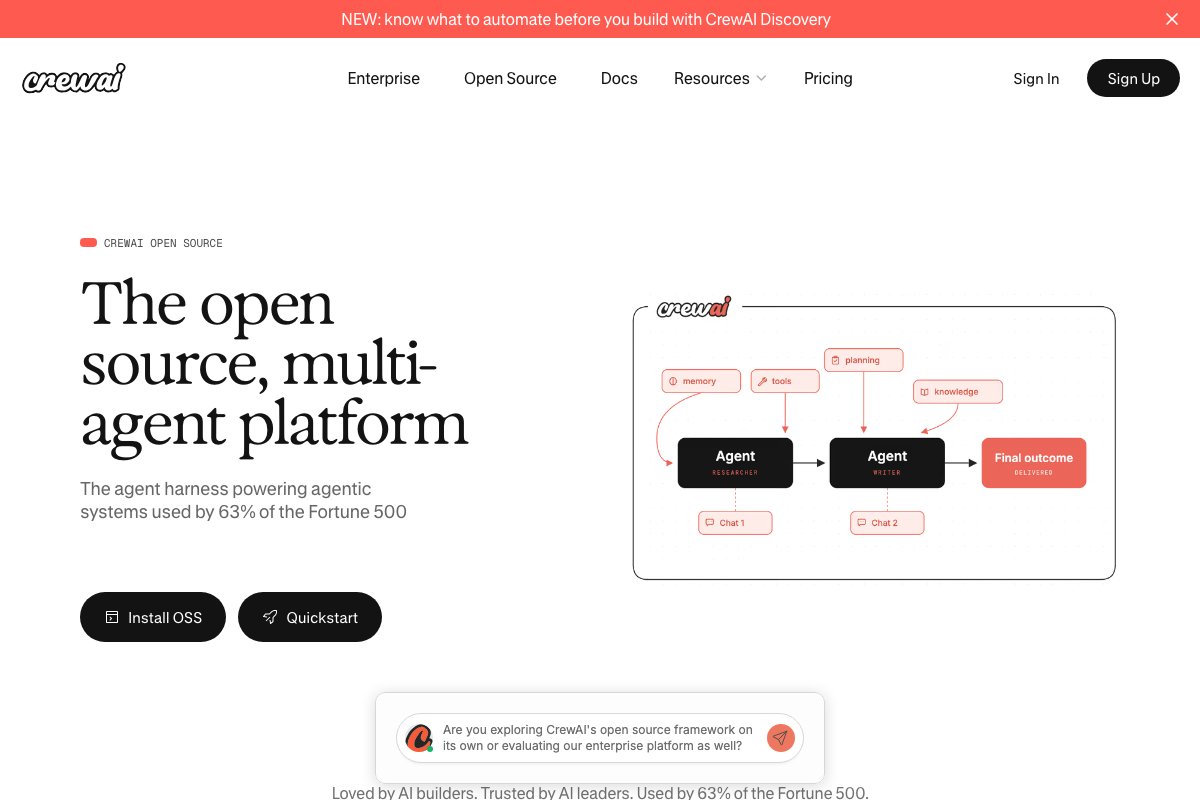
Agent collaboration. Agents can delegate sub-tasks to other agents within the crew. The delegation handshake includes the task description, expected output, and any context the delegator wants to pass. The receiving agent works the sub-task and returns the result. This is the multi-agent loop done right.
Process types. Sequential (task A then task B then task C) is the default and the most predictable. Hierarchical (a manager agent assigns and reviews work) handles dynamic workflows but is harder to debug. Most production deployments stick with Sequential.
Memory. Built-in short-term (per execution), long-term (across executions), and entity memory (about specific things mentioned). The defaults are sensible; tuning the memory layer is where production teams find efficiency gains.
Pricing analysis
The framework is free; you pay for the LLM tokens your agents consume. A typical Crew with 3 agents and 5 tool calls per task costs $0.05-0.50 per task depending on model and complexity. At 1,000 tasks/day that’s $50-500/day in LLM costs alone — multi-agent setups burn tokens.
Enterprise pricing isn’t public. Anecdotally it starts in the low five-figures annually for production deployments with observability and SOC2 — fair for the value but you have to engage sales.
Compared to Lindy’s flat monthly tiers, CrewAI’s variable cost can be higher OR lower depending on usage pattern. Visualize it: below 1,000 tasks/month, Lindy wins on simplicity; above 10,000 tasks/month with diverse models, CrewAI wins on flexibility.
Strengths
The multi-agent abstraction is genuinely useful for problems that fit. When you need a research agent, a synthesis agent, and a critique agent working together, CrewAI’s structure pays for itself in code clarity and debuggability versus rolling your own orchestration. Few competing frameworks come close to this maturity.
CrewAI Enterprise’s observability is best-in-class for multi-agent systems. Full traces of inter-agent communication, replay capability, eval integration, and policy enforcement — this is what production-grade agent ops looks like in 2026.
Weaknesses
Python-only is a real constraint for teams whose stack is TypeScript-first. There’s no official JS framework and the third-party ports lag behind. If you’re a Node shop, you’ll either run a Python sidecar or pick a different framework.
The framework’s defaults bias toward multi-agent solutions. New users build crews of 5-7 agents for problems that one agent could handle. The result is higher token costs and harder debugging. The documentation has improved on this, but the cultural tendency persists.
Verdict
CrewAI is the right framework when multi-agent collaboration genuinely solves your problem — and the wrong framework when it doesn’t. Diagnose the work first: if you can solve it with one good prompt and a tool list, do that. If the work has clear role separation and handoffs, Crew is the cleanest abstraction available. The Enterprise platform is worth evaluating once you’re past prototype stage. See FAQ below.
FAQ
-
When should I use Crew vs a single-agent framework? +
Use Crew when tasks decompose naturally into roles (researcher + writer + reviewer) with handoffs. Use a single-agent framework when the work is one continuous reasoning chain. Most production teams find single agents handle 70%+ of use cases acceptably.
-
Is the Crew open-source free version production-viable? +
Yes — many production deployments run on the OSS framework. The Enterprise platform adds observability, governance, and hosting. For teams with strong DevOps, OSS is enough; for teams that want managed infra and SOC2 compliance, Enterprise saves months.
-
How does Crew handle agent failures? +
Crew supports task-level retry, fallback agents, and human-in-the-loop intervention points. Defining these requires explicit configuration — the framework doesn't auto-magic failure handling. This is right but adds work.
-
Can Crew agents call external tools? +
Yes. Each agent gets a tool list; tools can be HTTP APIs, local Python functions, or MCP servers. Tool integration is more code-heavy than Lindy or n8n but more flexible.
- LangChain vs CrewAI: Which agent framework fits your team?LangChain (with LangGraph) if you need explicit state machines, language parity, and mature observability; CrewAI if your problem decomposes naturally into collaborating roles with shared context.
- Lindy vs CrewAI: Which AI agent platform fits your team?Lindy if you need ops or sales teams shipping agents this quarter; CrewAI if engineers need to compose multi-agent collaboration for complex workflows.

Stéphane Viaud-Murat
CEO, mi4.fr